DevOps Misunderstood: Common Beliefs vs. Real Practice
DevOps is often misunderstood. Most beginners see the surface-level tools, but the real value lies in principles, scalability, and automation that drive business outcomes.

Welcome to the AKVAverse — where DevOps, Cloud, and AI come to life.
I’m Abhishek Veeramalla, aka the AKVAman, your guide through the chaos.
When people hear "DevOps," they often think of CI/CD pipelines, Git repos, and YAML files.
But that's just the surface. Real DevOps is about collaboration, automation, scalability, and solving real-world production challenges.
In this issue, we cut through the noise and explore the most common misconceptions about DevOps — and reveal what it actually means in practice.
What People Usually See as DevOps
CI/CD: Most people think DevOps is just about setting up CI/CD pipelines to automate builds and deployments. But CI/CD is only one piece of the DevOps puzzle.
Git Repos: To many, DevOps means pushing code to Git and managing pull requests. In reality, Git is just a tool — collaboration and delivery strategies matter more.
Monitoring: People assume setting up a few dashboards with Grafana or Prometheus means they’re "doing DevOps."But true DevOps focuses on actionable observability, alerting, and response strategies.
Managing Releases: Beginners assume DevOps is about versioning and deploying software. But release management is only one part of the broader DevOps lifecycle.
Writing YAMLs: YAML has become the face of DevOps for many new engineers.
But YAML is just syntax — what matters is the system you’re defining and automating.
What DevOps Actually Is
A Culture of Collaboration: DevOps breaks silos between development and operations, fostering shared responsibility for building, testing, and running software.
Kubernetes: DevOps often means deploying, scaling, and managing applications using Kubernetes — the backbone of modern infrastructure.
Infrastructure as Code (IaC): DevOps uses tools like Terraform or CloudFormation to provision infrastructure automatically, safely, and repeatedly.
Observability & Monitoring: DevOps teams use logging, metrics, and tracing to understand system behaviour, detect issues early, and respond faster to incidents.
Branching Strategy: A solid DevOps practice includes designing Git branching strategies like GitFlow or trunk-based development to streamline delivery.
Cost Optimisation: DevOps involves selecting efficient resources, autoscaling, and monitoring usage to reduce cloud bills without sacrificing performance.
Scalability: DevOps ensures systems can scale with traffic — through load balancing, horizontal scaling, and container orchestration.
Automation at Every Stage: From infrastructure provisioning to testing and deployment, DevOps emphasises automation to reduce errors and increase speed.
Availability: It’s about uptime and reliability — using health checks, failovers, and monitoring to keep services running 24/7.
Handling Production Issues: DevOps teams are responsible for observability, alerts, logs, and quick incident responses — not just deployments.
DevOps isn’t about tools — it’s about mindset.
While YAMLs and CI/CD pipelines are visible at the surface, real DevOps runs deeper: collaboration, resilience, scalability, and smart automation.
As the AKVAman, my mission is to help you go beyond the buzzwords — and truly understand how to build systems that work at scale, in production, and under pressure.
Stay curious, stay hands-on — and remember: real DevOps happens below the surface.
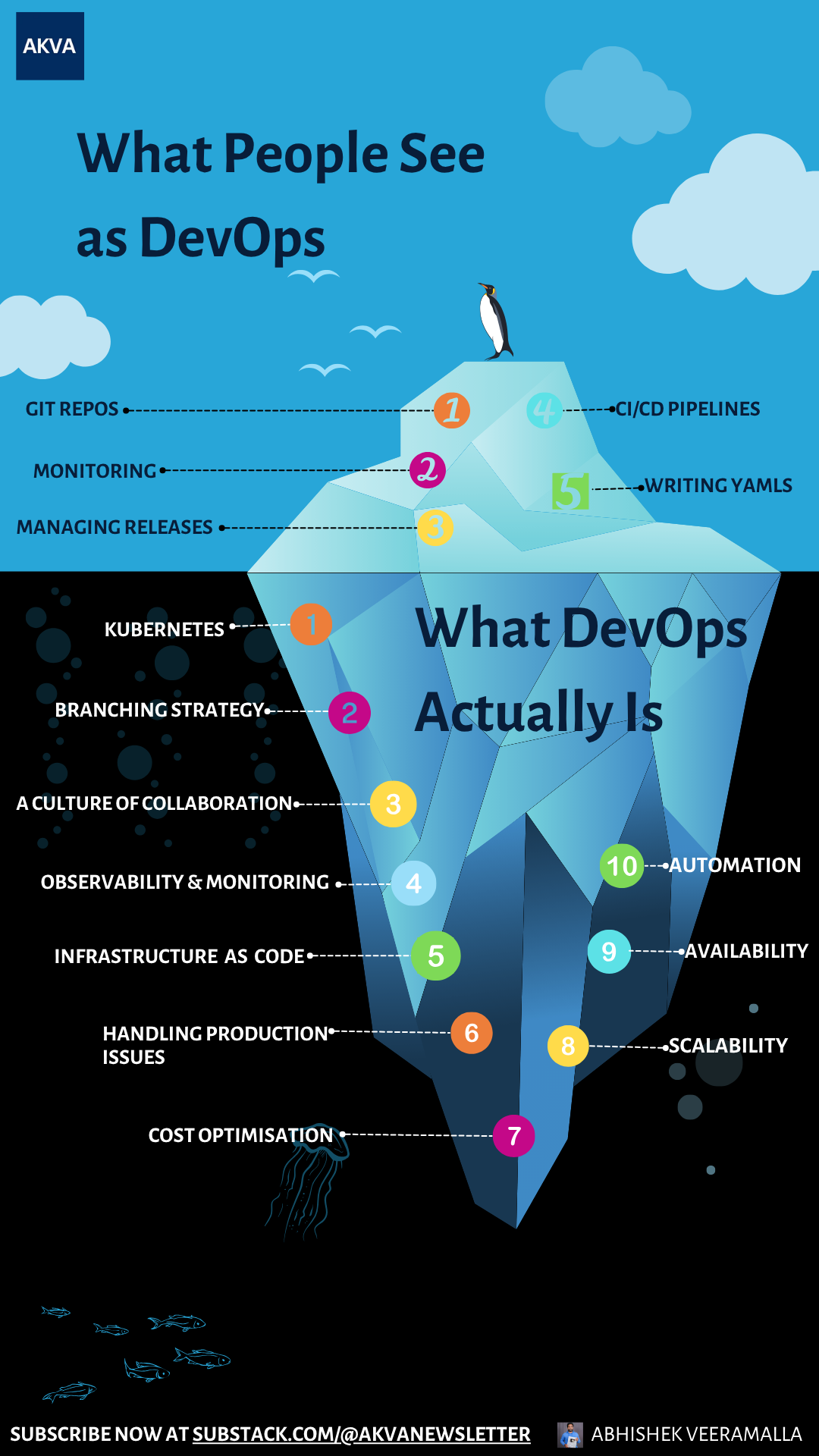
DevOps is definitely misunderstood by many 🙂
Newsletter has given the best idea of DevOps and what it actually look like