DevOps VS Platform Engineering
Engineering the Future: From DevOps Culture to Platform-Centric Delivery

Hello Everyone
Welcome again to the AKVAverse, I’m Abhishek Veeramalla, aka the AKVAman, your guide through the chaos.
Ever wonder who is really powering your CI/CD pipelines and developer tools behind the scenes?
DevOps engineers and platform engineers both play crucial roles in modern software delivery, but their focus and impact differ significantly. In this issue, we will discuss what sets both of them apart and how each one accelerates development in unique ways.
What is DevOps?
DevOps is a software delivery methodology that aims to bridge the traditional gap between development and operations teams. Its primary objective is to accelerate the delivery lifecycle, increase throughput, and enhance software quality. At its core, DevOps is a cultural movement centered around fostering developer autonomy, automation, and collaboration.
Key practices include:
Implementing CI/CD pipelines
Using repeatable test suites and automated security monitoring
Enabling developers to access live infrastructure
What is Platform Engineering?
Platform Engineering is a practical strategy for realizing DevOps outcomes by designing and creating Internal Developer Platforms (IDPs). These platforms serve as an operational hub for development teams, providing everything needed to deliver high-quality software on time.
Key practices include:
Providing self-service, on-demand access to infrastructure.
Offering capabilities that help developers set up new environments and test changes efficiently.
Enabling team leaders to enforce security and governance policies centrally and consistently.
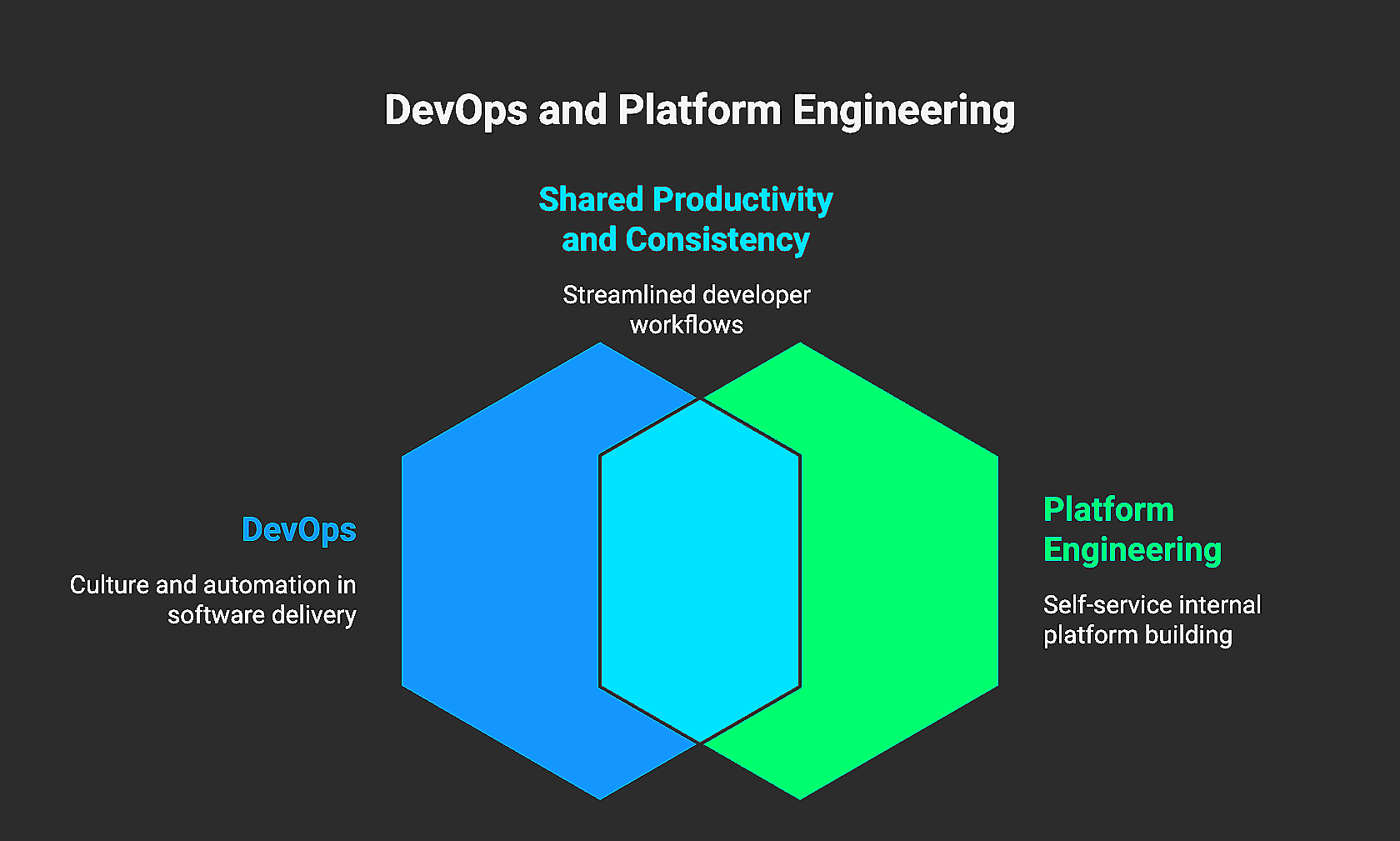
How are Platform Engineering and DevOps Different?
Platform Engineering and DevOps complement each other but differ in focus and implementation:
DevOps: Focuses on culture, automation, and collaboration across the entire software delivery lifecycle, promoting shared responsibility between development and operations.
Platform Engineering: Concentrates on building and maintaining a self-service internal platform that provides standardized tools and environments for developers, improving productivity and consistency.
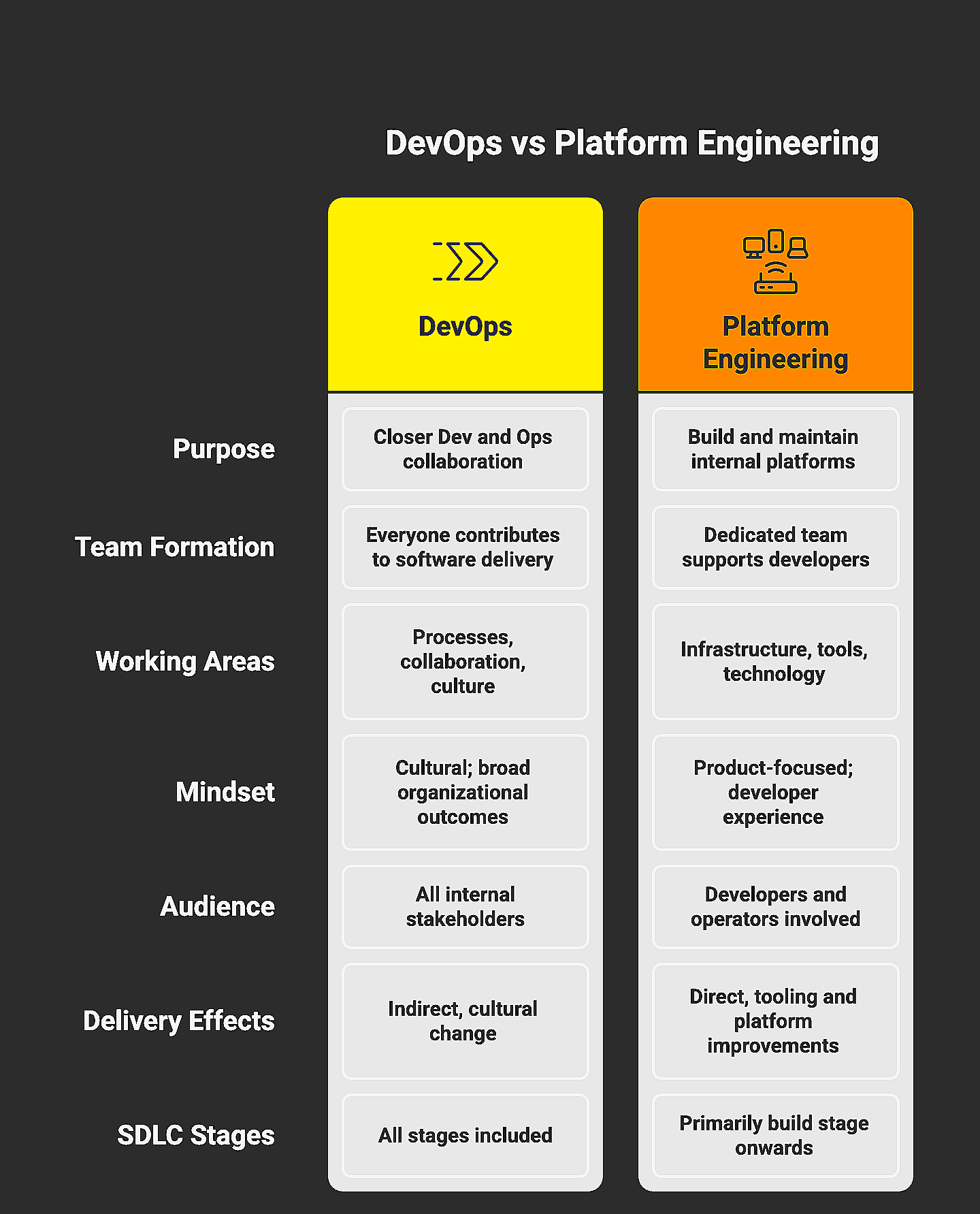
Platform Engineering vs. DevOps: Roles and Responsibilities
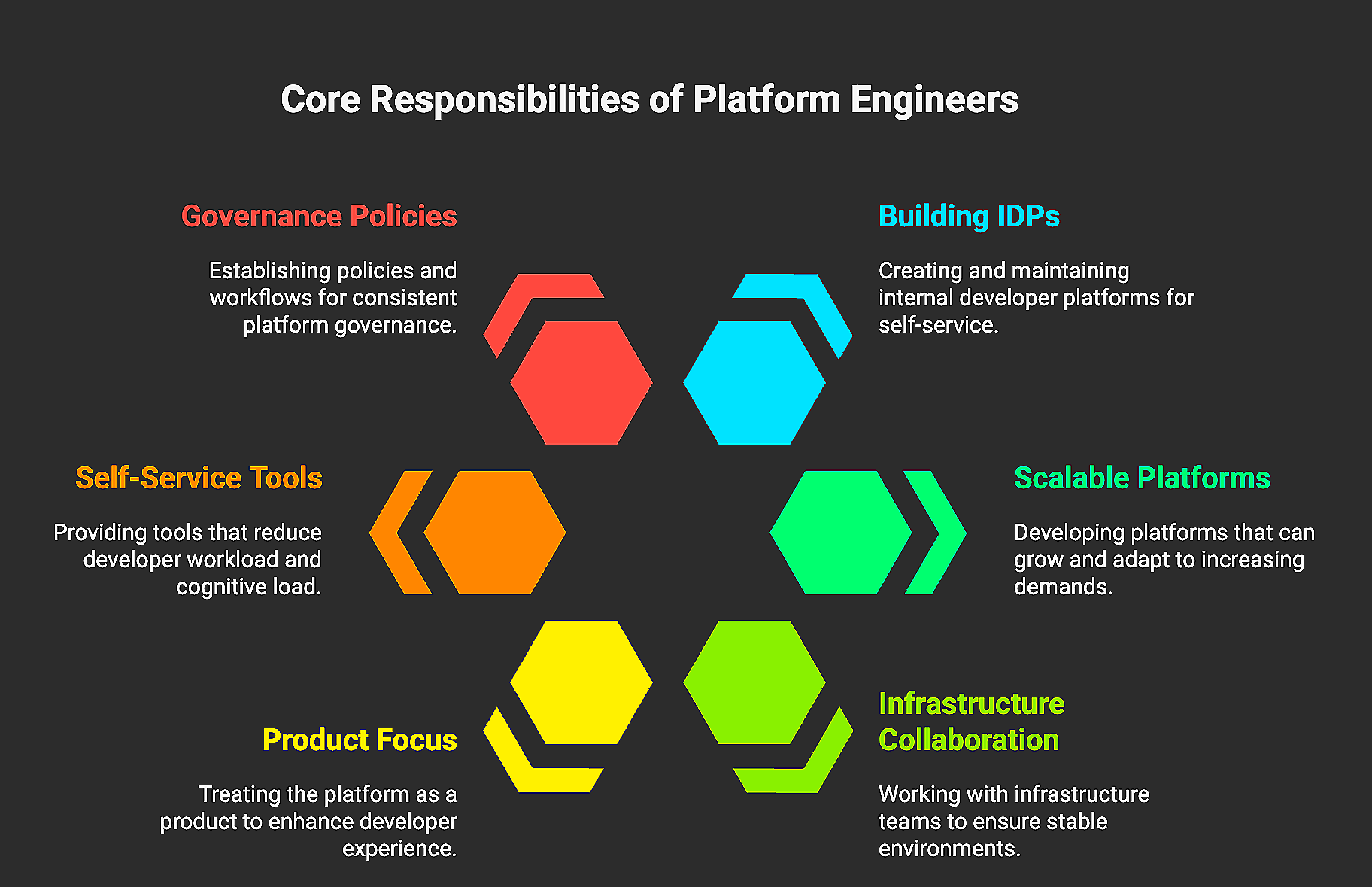
Platform Engineers:
Build and maintain internal developer platforms (IDPs) for developers to self-serve.
Focus on creating scalable, reusable platforms and developer tools.
Work closely with infrastructure to provide stable and consistent environments.
Treat the platform as a product, focusing on improving developer experience.
Provide self-service tools to reduce developer workload and cognitive load.
Create environments, governance policies, and standard workflows.
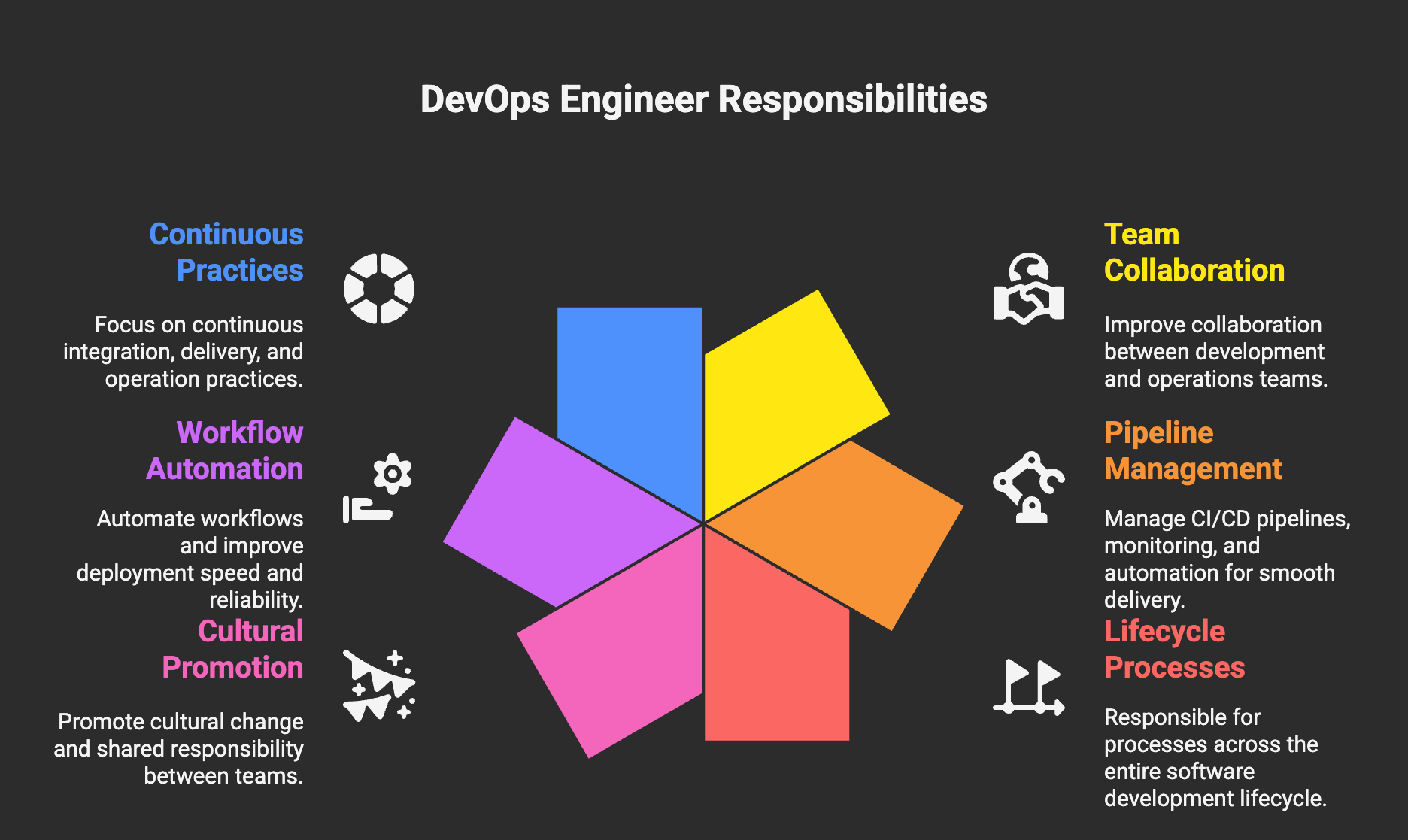
DevOps Engineers:
Bridge development and operations teams to improve collaboration.
Manage CI/CD pipelines, monitoring, and automation to ensure smooth delivery.
Responsible for processes across the entire software development lifecycle, including planning.
Promote cultural change and shared responsibility between teams.
Automate workflows and improve deployment speed and reliability.
Focus on continuous integration, delivery, and operation practices.
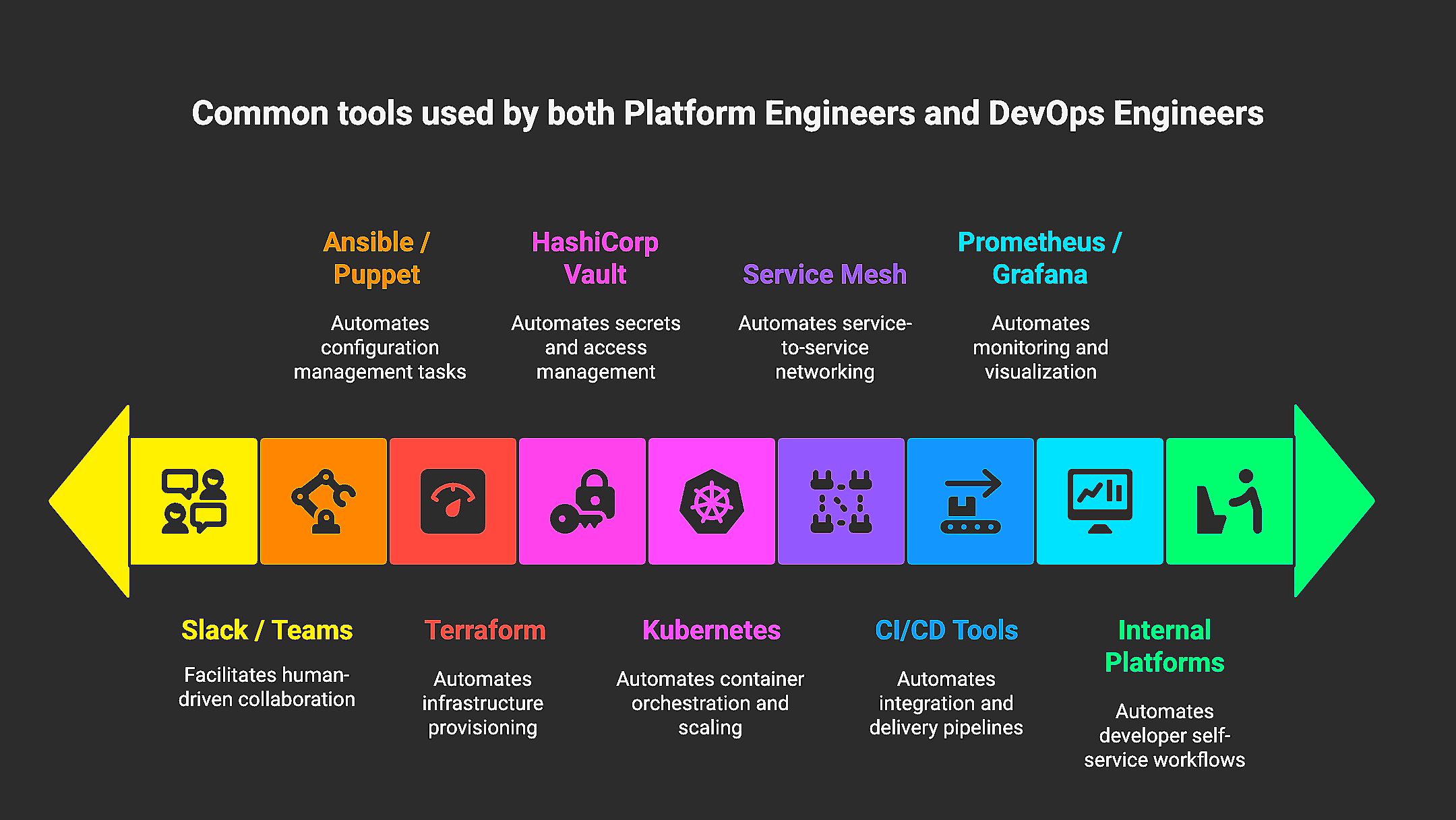
Here are the common tools used by both Platform Engineers and DevOps Engineers
Kubernetes: Container orchestration for managing and scaling applications.
Terraform: Infrastructure as Code tool for provisioning and managing cloud infrastructure.
Docker: Container platform for packaging and running applications.
Jenkins / GitHub Actions / GitLab CI/CD / Argo CD: Continuous integration and delivery automation.
Ansible / Puppet / Chef: Configuration management and automation tools.
Prometheus & Grafana: Monitoring, metrics, and visualization tools.
HashiCorp Vault: Secure secrets and access management.
Slack / Microsoft Teams / Jira: Communication, collaboration, and workflow management.
Service Mesh tools like Istio or Linkerd: For managing service-to-service networking.
Internal Developer Platforms (IDPs) or custom portals: For self-service developer tools and workflows.
A real use case that illustrates the roles of platform engineering and DevOps:
Consider a large software company that wants to improve developer productivity and speed up software delivery.
The platform engineering team creates an Internal Developer Platform (IDP), which is a self-service portal designed to make developers’ work easier. It provides ready-to-use tools, standard workflows, infrastructure building blocks, and helpful documentation built specifically with developers’ needs in mind. The team listens to developers’ challenges, continually improves the platform based on their feedback, and empowers developers to quickly set up environments, access necessary services, and deploy applications, all without requiring them to be infrastructure experts.
At the same time DevOps team focuses on setting up continuous integration and continuous delivery (CI/CD) pipelines that automate the processes of building, testing, and deploying code. This automation helps catch bugs early, minimizes errors, and accelerates the release cycle. By embedding these DevOps practices across the entire software lifecycle, the team enhances transparency, fosters better collaboration between development and operations, and ensures that software is delivered faster and with higher quality.
A Thought to Leave You With
Platform engineering doesn’t replace DevOps; instead, it puts DevOps principles into practice by creating centralized platforms for developers. This combination brings together reliable automation, a better developer experience, and faster software delivery.
The best tech companies build a strong DevOps culture supported by platform engineering. They treat platforms like products for developers, hiding away infrastructure complexities so teams can focus on delivering real business value quickly and efficiently.
I have a lot of confusion between both. But after reading this newsletter this, i can proudly say I can differentiate between both.
IDP are like Old School Enterprise Service Bus (ESB) for me which integrates SOA like services which happens to be Services Built/Created by DevOps Engineers such as CI/CD, IaC, Policy as a Code etc.
The ESB Style integration tasks (and a bit more) are done by Platform Engineers.